
These questions stayed with me long after childhood—and eventually led me to one of the most incredible stories in human exploration: the 1960 descent of the Bathyscaphe Trieste to the deepest place on Earth. The deepest dive in history reached 10,911 meters at the Challenger Deep in the Mariana Trench—a place so extreme that even today, very few humans have ever been there.
Let’s dive in.
Table of Contents
Extraordinary Ordinary Day: The Deepest Dive in History Begins
23rd of January 1960 was a day like any other. But for Jacques Piccard, Don Walsh, and their team, this was D-day. It took years of effort to be here—in the middle of the Pacific Ocean, southwest of Guam—on the day that would make history.
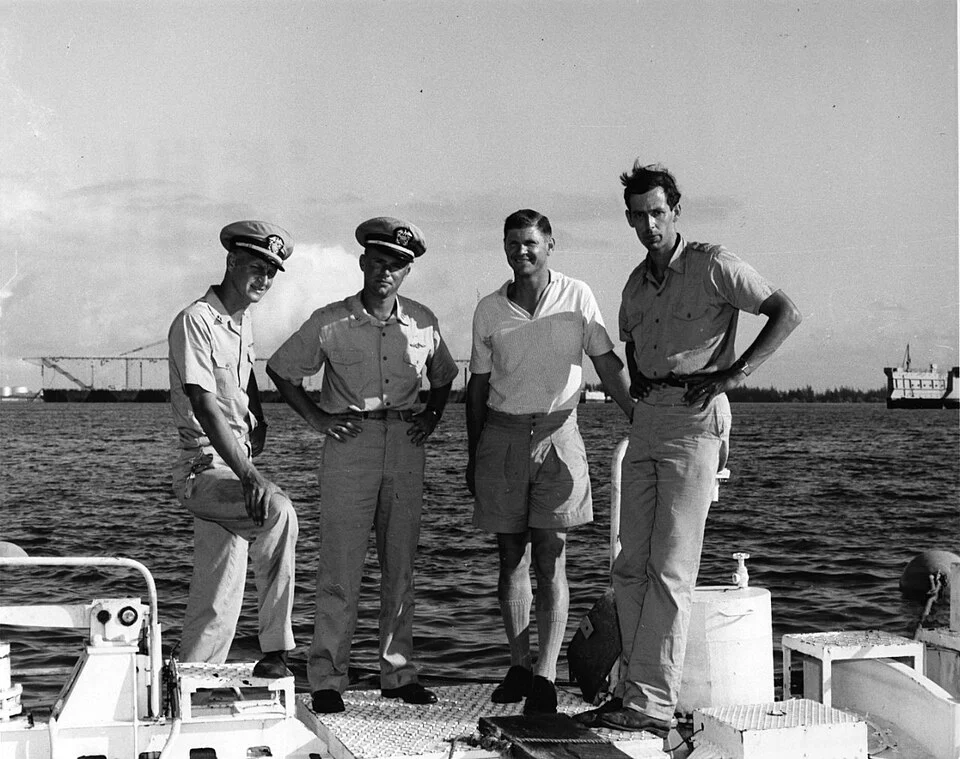
Jacques Piccard, Don Walsh (from right). Image credit: US Navy
The support ship USS Wandank was hovering above the Challenger Deep, the deepest known place in the world’s ocean. Two men were about to attempt something no one had ever done before: reach the bottom—and make it back alive.
No one knew for sure if that second part was even possible.
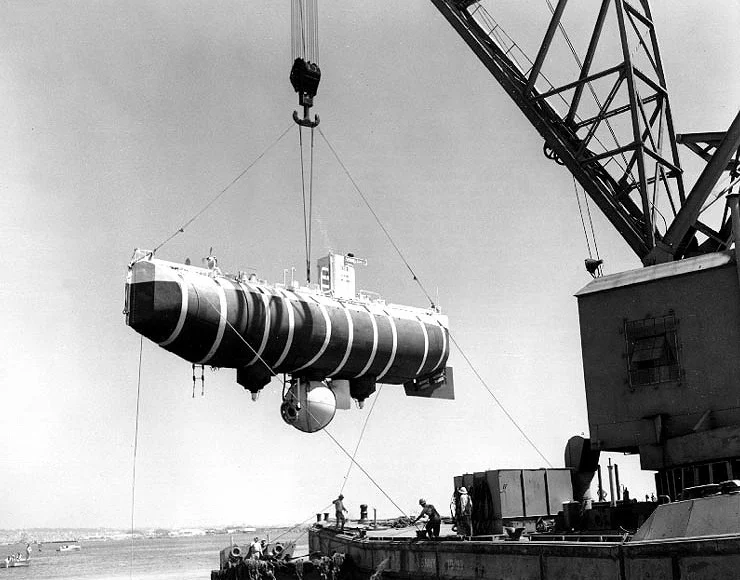
Trieste (1958 – 1963) is hoisted from the water by a floating crane, during testing by the Naval Electronics Laboratory. Image credit: US Navy
The Machine That Shouldn’t Exist
To make their dream come true, they had the most advanced deep-sea exploration technology onboard: the Bathyscaphe Trieste. The first machine ever designed to dive this deep—and return.
Trieste was the brainchild of Auguste Piccard, Jacques’ father. An engineer known for high-altitude balloon experiments, he took that knowledge and instead of going up, he looked down.
So the first bathyscaphe, FNRS-2, was born—and later its successor, Trieste.
The concept was simple.
A kind of “underwater balloon.”
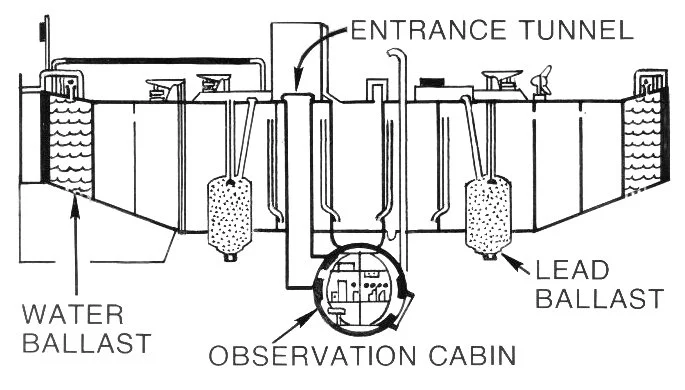
Schematic drawing of Trieste. Image credit: Pearson Scott Foresman
How Bathyscaphe Works?
The crew would sit inside a pressure-resistant sphere, attached to a large float filled with gasoline (lighter than water) to provide buoyancy. To descend, heavy ballast would pull the craft down. To ascend, the ballast would be released.
Simple and effective—on paper.
But the ocean is not paper.
After years of engineering challenges and testing, Trieste was finally ready.
Did you know?
While designing Trieste’s ballast system, engineers faced a critical problem. If the release system failed at depth, the crew would be trapped forever.
Instead of using electricity to open the ballast doors, they used it to keep them closed. If power failed—the ballast would automatically release. The craft would rise.
Simple. Genius. Life-saving.
The Descent Begins
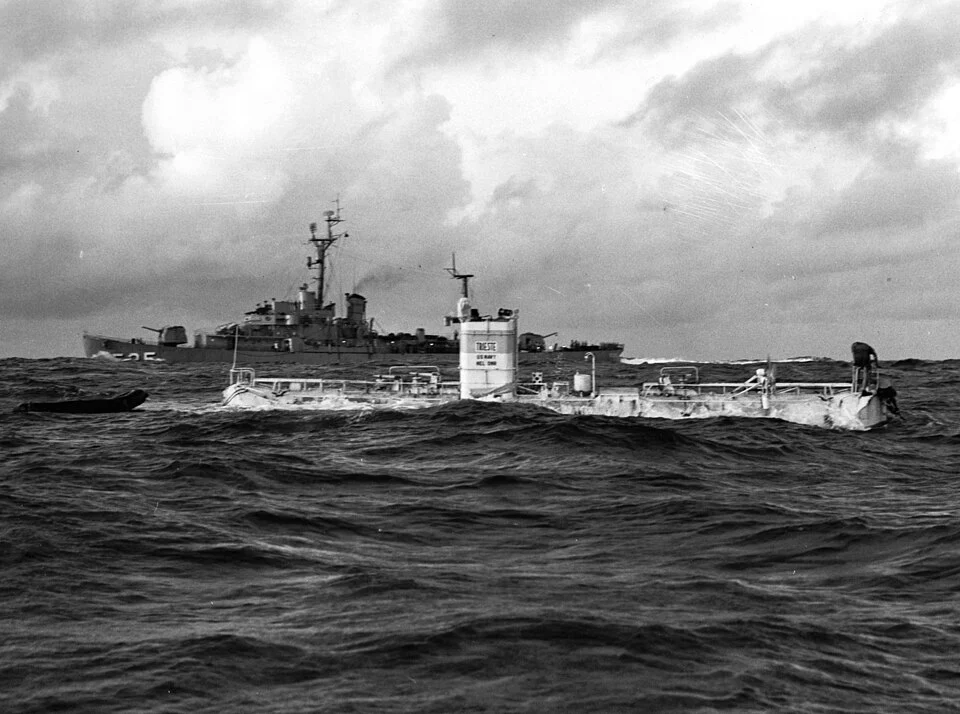
Trieste on the surface. Image credit: Pearson Scott Foresman
At 08:23 AM, the U.S. Navy lieutenant Don Walsh and Swiss oceanographer Jacques Piccard climbed down through the hatch. The hatch of the 2.16-meter diameter steel pressure sphere was sealed. There was no turning back now.
Now they were alone.
Ahead of them: nearly 5 hours to reach the bottom.
Into the Darkness
The submersible sank, the sunlight faded. Then it disappeared completely. Darkness—total and absolute—surrounded them. No light. No sound beyond the creaking of the vessel.
Just pressure building with every meter.
At around 9,000 meters, a loud crack echoed through the vessel. One of the outer Plexiglas windows had partially fractured.
Turning back would have been understandable. They continued. Because this was the edge of human exploration—and they were already too far to stop.
Did you know?
At that depth, if the pressure sphere failed, it would implode—collapse inward instantly under extreme pressure—in about 1–2 milliseconds.
Faster than the human brain can process.
The crew would not even have time to react.
As Don Walsh later told James Cameron before his own dive:
“If you live to hear the crack, you’re okay…” for that moment.
The Bottom of the World: Reaching Challenger Deep
After nearly five hours, the altimeter read 10,911 meters. Trieste touched the seafloor. The deepest known point on Earth.
For a moment, the descent stirred up sediment, creating a cloud around them. Then it slowly settled.
And there it was. Stillness.
For about 20 minutes, Piccard and Walsh sat in complete darkness.
They observed a silent, desolate landscape, a flat seabed stretching into nothingness, fine particles drifting down—marine snow and something unexpected.
Piccard reported seeing what looked like a flatfish although this statement was later debated.
But the conclusion was clear. Life exists even under extreme pressure. Even here… life finds a way.
That moment changed how we understand the deep ocean.
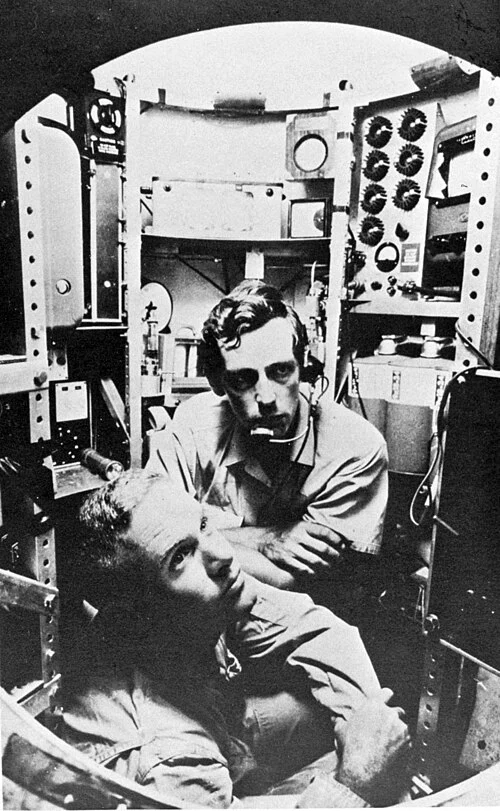
Walsh and Piccard in Trieste. Image credit: Archival Photography by Steve Nicklas, NOS, NGS Navy
The Return
After just 20 minutes at the bottom, it was time to leave. The ballast was released. Trieste began its slow ascent. Slowly, almost imperceptibly, they started rising back toward the world they knew.
It took about 3 hours and 15 minutes to reach the surface. Darkness faded. Light returned. They had done it. They had reached a place no one would visit again for 52 years—until James Cameron made his solo dive in 2012.
Dive Specs
- Craft: Bathyscaphe Trieste (built 1953)
- Depth reached: 10,911 meters
- Pressure: ~1,100 bar (~1,000× surface pressure)
- Temperature: ~1–4°C
- Descent time: 4 hours 48 minutes
- Bottom time: ~20 minutes
- Ascent time: 3 hours 15 minutes
- Specimens collected: None (visual observation only)
But where exactly is this place—and why does it matter?
Where Is Challenger Deep Located? (Deepest Place in the Ocean)
After following the journey of Jacques Piccard and Don Walsh to the bottom of the ocean, let’s zoom out and look at where they actually went.
The deepest known point in the ocean is the Challenger Deep, located within the Mariana Trench in the western Pacific Ocean, southwest of Guam. The maximum depth has been measured at ~10,900–11,000 meters.
If you dropped Mount Everest into the trench, its peak would still be more than 2 km underwater.
Trieste Deepest Dive FAQ
How deep is the deepest part of the ocean?
The deepest known point is the Challenger Deep in the Mariana Trench, reaching about 10,900–11,000 meters.
Who made the deepest dive in history?
Jacques Piccard and Don Walsh in 1960 aboard the Bathyscaphe Trieste.
How much pressure is at the bottom of the ocean?
Over 1,000 times atmospheric pressure—equivalent to about 50 jumbo jets pressing down on an area the size of your hand.
Can humans dive that deep today?
Yes, using specialized submersibles like the Deepsea Challenger or modern research vehicles.
Why is deep-sea exploration important?
It helps us understand life on Earth, discover new species, study climate processes, and protect fragile ecosystems.Divers can protect reefs by maintaining good buoyancy control, avoiding contact with coral, using reef-safe sunscreen, supporting marine protected areas, and choosing ethical dive operators.
Continue Exploring the Ocean Depths
The story of the deepest dive is just the beginning. The deeper you go, the more extreme—and fascinating—the ocean becomes.
Want to understand how the ocean changes with depth?
Explore the different ocean zones and what lives in them
Interested in extreme environments?
Learn about ecosystems that exist without sunlight