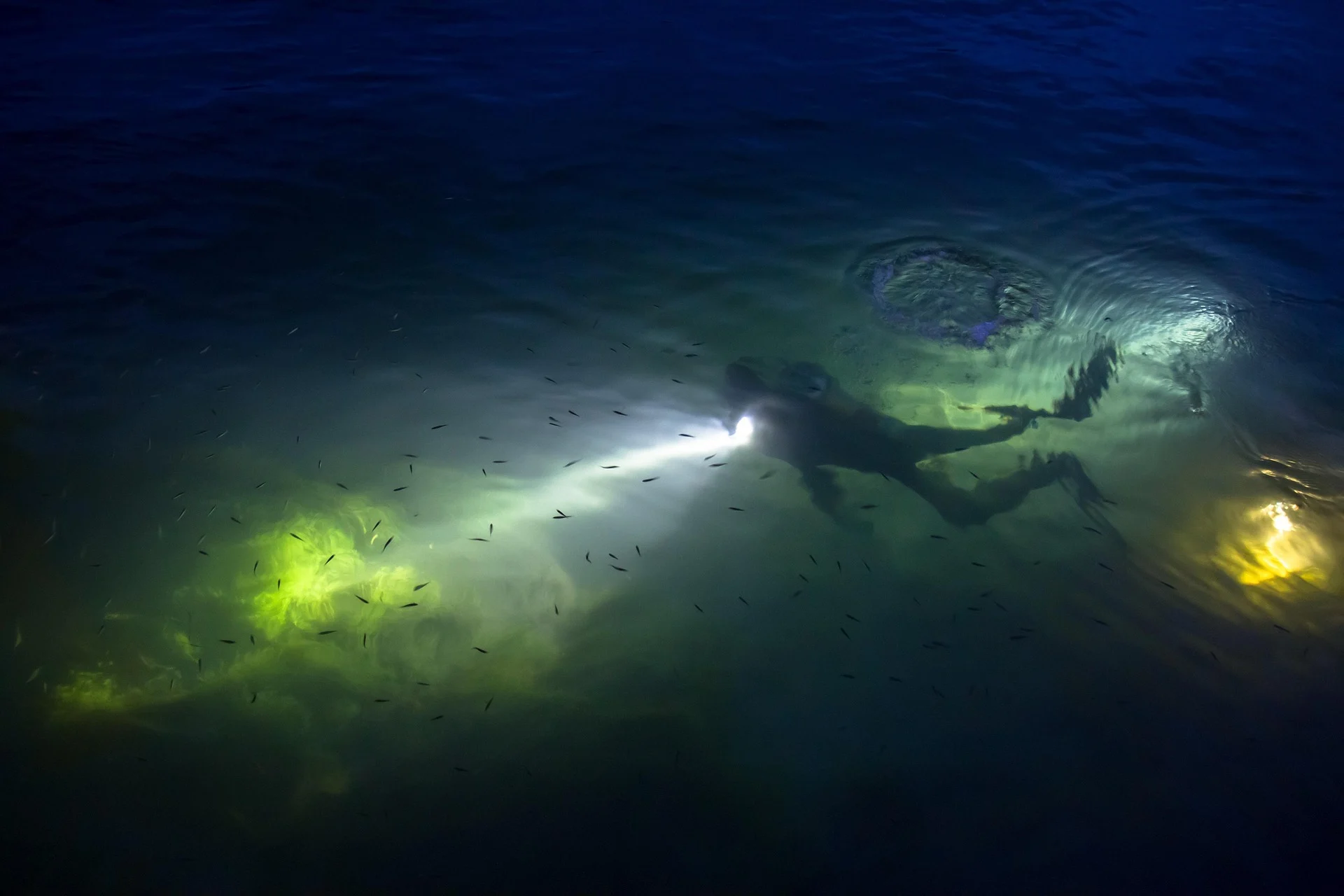
Image credit: US Navy
But trust me — this idea couldn’t be further from the truth. Night dive is pure magic.
And once you try it, you’ll wonder why you waited so long. Let’s dive into what night diving really feels like, why it’s safe when done properly, and why it might just become your new favorite underwater experience.
What It Takes: How to Stay Safe and Enjoy the Dive
It’s important to say that night dives require a different approach, yet they can be done safely and the rewards make every moment worth it"
Light is your lifeline (and your best friend)
Natural light is nearly nonexistent underwater at night, so a primary dive light is essential. Always back it up with a secondary torch in case of failure.
Choose your lights carefully, depending on your intended use. There are plenty of options: narrow beam, wide beam, adjustable beams, rechargeable batteries, and more. Choose a light that fits the type of diving you do.
GOLDEN RULE
Once your light is ON, do not turn it OFF.This reduces the risk of switching failures and keeps communication consistent.
How to Navigate Safely During a Night Dive
Without sunlight, you lose familiar reference points. Stay close to your buddy and group, especially on your first few dives. If you’re diving from a liveaboard, boats often lower strobe lights on the line so you can find your way back easily. Many divers attach a small tank marker light (colored or white) for easy identification. Some dive lights even offer color-changing modes, which help differentiate divers in low visibility. Different colors make it easier to tell who’s who.

Image credit: Nicholas Cortiana on Pixabay
Hand Signals Need to Be Seen!
Learn basic light signals that may be useful. Standard hand signals become nearly invisible in the dark without proper illumination. Make sure you use your light to make hand signals visible.
USEFUL TIP
Do not point your light beam into other divers’ faces. You can temporarily blind them. They will use completely different words than “Thank you” after the dive, trust me…
Experienced buddy is a good start
You’d probably agree that it is not a good idea to do your first few night dives with a buddy who has never done it before. If you can, choose an experienced buddy who has completed several night dives and feels fully comfortable guiding you.
What is a Buddy System?
Diving isn’t a solo sport — and for good reason. The buddy system is one of the most fundamental principles of scuba diving safety. Whether you’re a beginner or a seasoned diver, understanding and applying it properly can be the difference between a smooth dive and a potential emergency.
Dive in3 Common Myths About Night Diving (And the Truth Behind Them)
Myth 1: It's dangerous because you can’t see anything.
Truth: With proper lights and an experienced buddy, visibility is controlled, predictable, and often clearer than daytime diving.
Myth 2: All marine animals are aggressive at night.
Truth: Most creatures avoid divers entirely. You’ll simply observe their natural routines — safely.
Myth 3: Only advanced divers should attempt it.
Truth: Beginners can try night diving with the right guidance. Many divers find their night dive easier than their first deep dive - this was my case too.
What It Gives: A Completely Different Underwater World
What changes underwater after sunset
Everything. Night dives offer a different look at life in the ocean — an amazing transformation of the same dive site you explore during the day takes place once the sun sets.If you think the nighttime dive site will be a quiet place with all inhabitants sleeping peacefully, you cannot be more mistaken. The dynamics of the reef changes when the sun goes down. Creatures active during the day start to prepare for the night. What is night for some is daytime for others. Get ready for a nighttime show — especially the glowing plankton that appears like underwater stars.
My First Night Dive
Red Sea, Egypt - 2012
I got into night diving during a liveaboard trip in Egypt. Nervous but lucky to have my friend and experienced scuba instructor, Kevin, on my side as a buddy. His calm attitude made me feel relaxed as soon as we jumped in. I couldn’t resist the impression of being in a Star Wars movie, seeing all the “light sabre” beams searching the reef.
The world that unfolded in front of us was completely different from the reef during the day. We saw night crews in action — hunting lionfish, octopuses, tiny invertebrates, and little critters you don't see during day dives. Even those taking a well-deserved rest, like sleeping parrotfish enclosed in their protective cocoons, were part of the show.
At that moment, it felt like the ocean was letting me in on a secret reserved only for those brave enough to dive at night. From that moment, the thrill of a night dive became irresistible.
Should You Try a Night Dive?
Absolutely yes — if you obey the rules. Safety is paramount, so do not neglect any checks, gear issues, or your own body signs. Choose an experienced diver as your buddy or a guide for your first dives.
Anything else?
Approach the dive calm and focused, ready to enjoy one of the most extraordinary underwater experiences available. Night dives aren’t something to fear — they’re something to fall in love with.
Ready for your first night dive?
Follow Happy Under Pressure for more scuba tips, gear guides, and dive inspiration — and join a community of divers who love exploring the underwater world after sunset.
FAQ
Is night diving safe?
Yes — when done with proper equipment, training, and planning. Always dive with a buddy, carry a backup light, and follow your dive guide’s instructions.
Do I need special equipment for a night dive?
You’ll need a primary and backup dive light, a tank marker, and possibly a strobe beacon from the boat for orientation.
What can I see at night that’s not visible during the day?
Nocturnal creatures like lobsters, crabs, hunting lionfish, and sleeping parrotfish wrapped in cocoons — all active only after sunset.
What about sharks and currents during night dives?
Usually dive sites with strong currents and sharks such as Daedalus Reef in Egypt do not allow night diving. If you cannot have control, do not dive the site.