
Ocean Zones Explained: From Sunlit Reefs to the Deep Sea
Image credit: Photo by Lucas Davies on Unsplash
The ocean isn’t one uniform world—it’s divided into distinct zones shaped by light, depth, and distance from land. Understanding these zones helps explain where marine life lives and how ocean ecosystems function.
What Are Ocean Zones?
Ocean zones are natural divisions of the ocean based on environmental conditions such as :
- Ligt
- Depth
- Pressure
- Temperature
- Distance from shore
Scientists use these zones to better understand how marine life is distributed—from sunlit coral reefs to the dark, high-pressure depths of the deep sea.
This diagram combines both vertical (depth) and horizontal (distance) ocean zones to give a complete picture of how the ocean is structured.
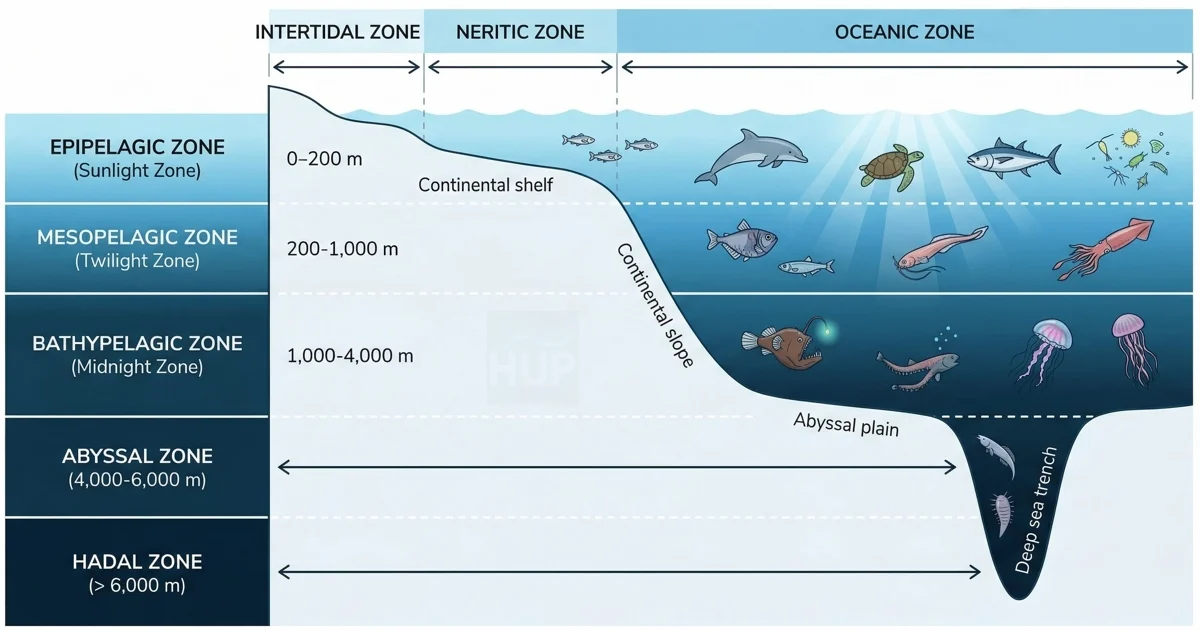
Image credit: Juraj Hrabovsky – HUP
How Ocean Zones Shape Marine Ecosystems
Ocean zones shape and support marine ecosystems, influencing where life can exist in the ocean.
From sunlit coral reefs near the surface to the mysterious creatures of the deep sea, each ecosystem depends on the unique conditions of its zone.
Understanding these zones reveals how the ocean is organized and why marine life is distributed the way it is and why marine habitats are found where they are.
Ocean Zones by Depth
One of the most common ways to divide the ocean is by depth, which directly affects light availability, pressure, and temperature.
Sunlight Zone (Epipelagic)
- Fully lit by sinlight
- Pressure: Low (1–20 bar)
- Temperature: Warm (~10–30°C / 50–86°F)
This is the ocean we know—and where all recreational and technical diving takes place and the only ocean zone where humans can freely explore without specialized vehicles.
The epipelagic zone is the ocean’s upper layer, extending down to about 200 meters, where sunlight penetrates the water and enables photosynthesis. This makes it the most productive and life-rich part of the ocean, supporting plankton, coral reefs, and most fish species.
Because sunlight drives the food chain here, nearly all marine life depends directly or indirectly on this zone—even species living far below it.
Accessibility: Fully accessible to divers
Typical life: Coral reefs, plankton, reef fish, sharks
Human presence: All diving, fishing, and most marine activity
Twilight Zone (Mesopelagic)
- Dim light
- Pressure: Increasing (20–100 bar)
- Temperature: Cold (~5–10°C / 41–50°F)
Beyond this point, humans cannot dive freely—only specialized submersibles can explore here.
The twilight zone (mesopelagic) is a dimly lit ocean layer where sunlight fades and photosynthesis is no longer possible. This zone contains one of the largest biomasses on Earth due to daily vertical migration.
During this process, many animals—especially small fish like lanternfish and zooplankton—move up toward the surface at night to feed and descend back into the depths during the day to avoid predators.
Accessibility: Submersibles and military submarines
Typical life: Lanternfish, squid, vertically migrating species
Human technology: Military submarines (~300–600 m), early research dives
Midnight Zone (Bathypelagic)
- Almost no light
- Pressure: High (100–400 bar)
- Temperature: Very cold (~2–4°C / 36–39°F)
In the bathypelagic zone, darkness is complete, and temperatures are near freezing. No sunlight reaches these depths, and pressure is extremely high.
Life here depends largely on organic material sinking from above—often called “marine snow”—as well as active predation. Light here is produced almost entirely by living organisms. Many species have evolved slow metabolisms and unique adaptations such as bioluminescence to survive in this energy-limited environment.
Accessibility: Deep-sea submersibles only
Typical life: Anglerfish, giant squid, deep-sea predators
Human technology: DSV Alvin (~4,500 m)
Abyssal Zone (Abyssopelagic)
- No light
- Pressure: Very high (400–600 bar)
- Temperature: Near freezing (~1–3°C / 34–37°F)
The abyssal zone (abyssopelagic) is a near-freezing, high-pressure, dark deep ocean environment with sparse life and with very little food reaching the seabed. This zone covers vast flat areas of the ocean floor and remains largely unexplored.
Despite this, life persists in surprising forms, including deep-sea invertebrates and microorganisms that can survive with minimal energy input.
Accessibility: Advanced deep-sea vehicles only
Typical life: Sea cucumbers, brittle stars, deep-sea fish.
Human technology: Kaiko (ROV) (rated to ~11,000 m)
Hadal Zone (Trenches)
- Total darkness
- Pressure: Extreme (600–1,100+ bar)
- Temperature: Near freezing (~0–2°C / 32–36°F)
The hadal zone is the deepest part of the ocean, found in trenches where extreme pressure and darkness create highly specialized ecosystems. Pressure here is extreme—more than 1000 times the atmospheric pressure at the surface.
Only highly specialized organisms can survive in these conditions, and much of this environment remains unexplored by humans. Fewer people have visited this realm than have walked on the Moon. Hadal zone includes the deepest known point on Earth: Challenger Deep (~10,900–11,000 m).
Accessibility: Specialized deep-submergence vehicles only
Typical life: Snailfish, amphipods, trench invertebrates
Who has been here:
- Trieste – First descent to Challenger Deep (1960)
- Deepsea Challenger – Piloted by James Cameron (2012)
OCEAN ZONES BY DISTANCE FROM SHORE
The ocean can also be divided horizontally based on distance from land. These zones help explain why coastal areas are rich in life, while the open ocean is more vast and less productive.
Intertidal Zone
Between high and low tide
The intertidal zone lies between high and low tide, making it one of the most dynamic environments in the ocean. Organisms here are exposed to both air and water, as well as strong waves and changing temperatures. As a result, species in this zone are highly resilient and adapted to constant environmental change.
Neritic Zone
From the shoreline to the edge of the continental shelf
Image credit: Photo by Francesco Ungaro on Unsplash
The most biologically productive region of the ocean. Sunlight, shallow depths, and nutrient input from land create ideal conditions for life.
This is where many of the ocean’s most important ecosystems are found, including coral reefs, seagrass meadows, and major fishing grounds.
Oceanic Zone
Vast open ocean that covers most of the planet.
Image credit: Photo by Oliver Tsappis on Unsplash
Beyond the continental shelf lies the oceanic zone. While nutrient levels are generally lower than in coastal waters, this zone supports large, mobile species such as whales, sharks, and tuna.
Life here is often adapted to long-distance movement and finding food in a more sparsely distributed environment.
WHY OCEAN ZONES MATTER
Ocean zones are more than just scientific categories—they explain how life in the ocean works.
From oxygen production in surface waters to carbon storage in the deep sea, each zone plays a vital role in maintaining the health of our planet.
Ocean ZOnes FAQ
What are the main ocean zones?
The ocean is divided into zones based on depth (epipelagic to hadal) and distance from shore (intertidal, neritic, oceanic).
What is the difference between neritic and oceanic zones?
The neritic zone is shallow and close to land, while the oceanic zone is the deep open ocean beyond the continental shelf.
Which ocean zone has the most life?
The epipelagic and neritic zones contain the most life due to sunlight and nutrient availability.