
Deep-Sea Hydrothermal Vents
Where life thrives without sunlight — powered by the Earth itself
Image credit: IFREMER (Richesses minérales des grands fonds)
Deep-sea hydrothermal vents are extreme ocean ecosystems where life thrives without sunlight, powered by chemical energy through a process called chemosynthesis. Found thousands of meters below the surface, these environments revealed for the first time that entire ecosystems can exist independently of the sun.
Table of Contents
What Are Hydrothermal Vents?
Hydrothermal vents are openings in the seafloor where superheated, mineral-rich water flows out from beneath the Earth’s crust. They form in tectonically active areas such as mid-ocean ridges and volcanic regions.
These vents were first discovered in 1977 near the Galápagos Rift, a finding that transformed our understanding of life in the ocean.
How Hydrothermal Vents Form
- Cold seawater seeps into cracks in the ocean crust
- It is heated by magma beneath the seafloor
- The water reacts with rocks, dissolving minerals and metals
- The superheated fluid rises and exits through vents
Did you know?
Vent fluids can reach temperatures of 350–400°C, but they do not boil because of the extreme pressure in the deep ocean.
As the hot fluid meets near-freezing seawater, minerals precipitate and form chimney structures:
- Black smokers → iron sulfide (dark plumes)
- White smokers → lighter minerals like barium and calcium
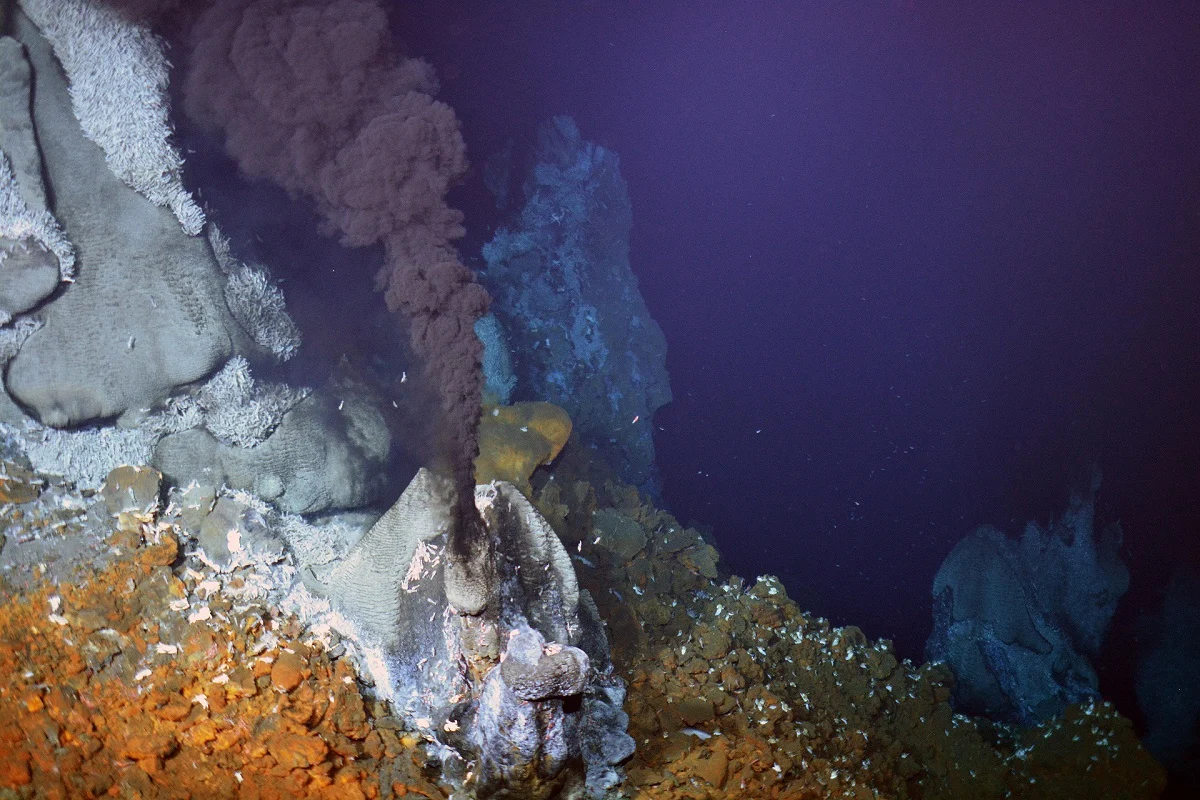
Black smoker. Image credit: IFREMER (Richesses minérales des grands fonds) published on Wikimedia Commons under CC A4.0 Intl. licence
How Hydrothermal Vent Ecosystems Work
Hydrothermal vent ecosystems are powered by chemosynthesis, not sunlight.
Chemosynthetic microbes use chemicals such as hydrogen sulfide to produce energy and organic matter. These microorganisms form the base of the food web, supporting complex communities of animals.
This makes hydrothermal vents one of the only ecosystems on Earth that do not depend on solar energy.
Life at Hydrothermal Vents
Despite extreme conditions, hydrothermal vents support diverse and unique life.
Key Species
Giant Tubeworms (Riftia pachyptila)
- Can grow over 2 meters long
- No mouth or digestive system
- Depend on symbiotic bacteria
Vent Shrimp and Crabs
- Adapted to high temperatures and toxic chemicals
- Often have reduced vision
Mussels and Clams
- Host chemosynthetic bacteria inside their tissues
Microbial Communities
- Form the foundation of the ecosystem
These species were completely unknown before the discovery of vents in 1977.
Extreme Conditions in the Deep Sea
Hydrothermal vents exist in one of the most hostile environments on Earth:
- Light - none (complete darkness)
- Depth - typically 2,000–4,000 meters
- Pressure - hundreds of times higher than at the surface
- Temperature - near 2°C seawater to over 400°C at vents
- Chemistry - rich in metals and toxic compounds
These extreme gradients can occur over just a few centimeters.
Hydrothermal Vents vs Coral Reefs
Hydrothermal vents and coral reefs are both biodiversity hotspots — but they function very differently:
- Coral reefs rely on sunlight and photosynthesis
- Hydrothermal vents rely on chemical energy from the Earth
This makes vent ecosystems entirely independent of sunlight — a rare phenomenon in the natural world.
Why Hydrothermal Vents Matter
Rethinking Life
Their discovery proved that life can exist without sunlight, reshaping biological science.
Origins of Life
Some scientists propose that early life on Earth may have developed in similar environments.
Life Beyond Earth
Hydrothermal vents are key models for potential life in subsurface oceans on moons like Europa.
Did you know?
More than 700 hydrothermal vent systems have already been discovered — yet scientists believe this represents only a fraction of what exists in the deep ocean.
.
Threats to Deep-Sea Vent Ecosystems
Deep-Sea Mining
Hydrothermal vents contain valuable minerals such as copper, zinc, and gold. Extraction could destroy entire ecosystems.
Ecosystem Fragility
Many vent species are highly localized, meaning the loss of a single vent field could lead to extinction.
Where Do Hydrothermal Vents Fit in the Ocean?
Hydrothermal vents are primarily found in the deep ocean zones, especially along mid-ocean ridges within the bathypelagic (midnight) zone, where sunlight never reaches.
They are closely linked to tectonic activity and play an important role in deep-sea ecosystems.
Frequently Asked Questions (FAQ)
What are hydrothermal vents?
Hydrothermal vents are openings in the seafloor where heated, mineral-rich water from beneath the Earth’s crust is released into the ocean.
How do animals survive without sunlight?
They rely on chemosynthesis, where bacteria convert chemicals like hydrogen sulfide into energy, forming the base of the food chain.
Where are hydrothermal vents found?
They are mainly located along mid-ocean ridges and volcanic regions, typically at depths between 2,000 and 4,000 meters.
How hot are hydrothermal vents?
Vent fluids can reach temperatures of up to 400°C, although surrounding seawater remains near freezing
Why are hydrothermal vents important?
They help scientists understand extreme life on Earth, the possible origins of life, and the potential for life beyond our planet.