
Coral Reefs
Coral reefs are living underwater ecosystems that support extraordinary marine biodiversity, shape the world’s most spectacular dive sites, and stand at the center of today’s ocean conservation challenges.
Image credit: Photo by Erick Morales Oyola on Unsplash
Coral reefs are among the most biodiverse and valuable ecosystems on Earth. Often called the “rainforests of the sea,” coral reefs support marine life, protect coastlines, and create some of the world’s most spectacular dive sites.
For scuba divers, coral reef diving offers unmatched biodiversity, color, and underwater landscapes. But these fragile ecosystems are under increasing pressure from climate change, pollution, and unsustainable human activity.
This guide explores coral reef ecosystems, coral reef diving best practices, coral bleaching science, and the most effective coral reef conservation actions divers can take.
Table of Contents
What Are Coral Reefs?
Coral reefs are underwater structures built by tiny marine animals called coral polyps. These polyps secrete calcium carbonate skeletons, which accumulate over thousands of years to form vast reef systems.
Despite their plant-like appearance, corals are animals. They belong to the group Cnidaria, which also includes jellyfish and sea anemones. Each coral colony consists of thousands of tiny polyps with tentacles surrounding a central mouth.
Most reef-building corals live in symbiosis with microscopic algae called zooxanthellae. These algae live within coral tissues, providing nutrients through photosynthesis in exchange for shelter. This partnership powers the entire coral reef ecosystem.
Because corals depend on symbiotic algae for energy, they are highly sensitive to temperature changes — which is why coral bleaching has become one of the most urgent environmental issues facing reefs today.
Did you know?
Coral reefs are visible from space — including the Great Barrier Reef, the largest living structure on Earth.
How Coral Reefs Are Built
Coral polyps extract calcium carbonate from seawater and build the reef structure layer by layer. Over thousands of years, countless generations create massive coral reef ecosystems that support extraordinary biodiversity.
Coral reefs form a vital link in the marine ecosystem connecting multiple habitats. Adjacent seagrass beds act as nursery grounds for juvenile fish, while mangrove forests provide nutrients, shelter, and coastal protection. Together, these ecosystems create an interconnected system that supports reef biodiversity and stabilizes shorelines.
Key Benefits of Coral Reefs
Biodiversity Hotspots
Coral reefs support more than 25% of all marine species despite covering less than 1% of the ocean floor — making them one of the richest ecosystems on Earth.
Natural Coastal Protection
Reef structures reduce the force of waves and storms, shielding shorelines from erosion and helping protect coastal communities and infrastructure.
Fisheries and Food Security
Millions of people around the world rely on reef fish and invertebrates for protein, livelihoods, and sustainable fishing economies.
Tourism and Local Economies
Reef-based activities — from scuba diving to snorkeling — generate billions in global tourism revenue and support jobs in coastal communities.
Climate Regulation and Carbon Cycling
Coral reef ecosystems play a role in global carbon cycling and help maintain ecological balance in tropical marine environments.
Scientific and Medical Discoveries
Corals and reef organisms are sources of novel compounds used in medicine — including antiviral and anticancer research.
Coral Reef Zones
Coral reefs are not uniform structures. Instead, they form distinct zones shaped by wave energy, sunlight, depth, and water movement. Each part of the reef supports different coral species, fish communities, and diving conditions.
Understanding reef zonation helps divers read the underwater landscape — and often explains why certain marine life appears in specific places. From calm lagoons to dramatic drop-offs, every section of the reef plays an important ecological role.
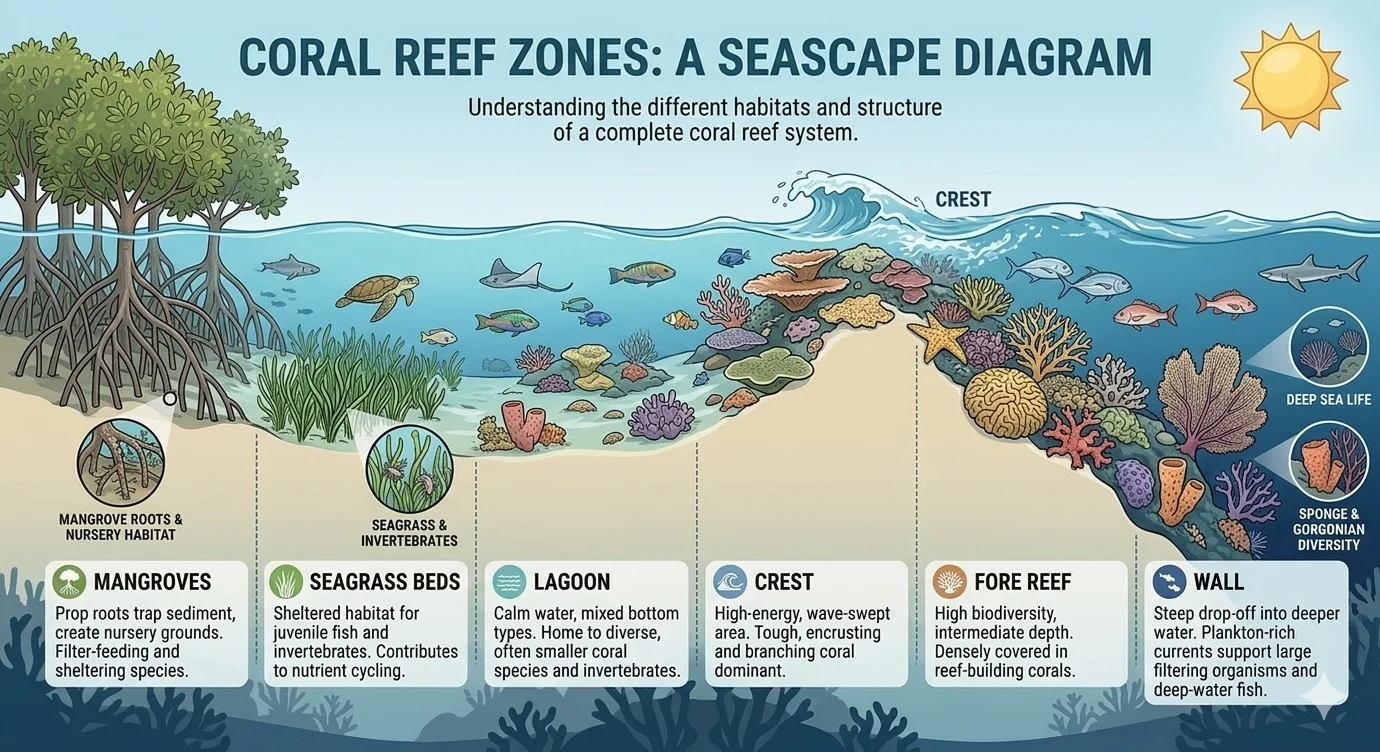
Coral reef zones. Image credit: Juraj Hrabovsky, HUP
Lagoon
A lagoon is a sheltered body of water located between the shoreline and the main reef structure. Lagoons are common in barrier reefs and atolls, but may be absent in many fringing reefs.
The lagoon typically has calm water, sandy or muddy bottoms, seagrass beds, patch reefs.
These sheltered environments often serve as important nursery habitats for fish and other marine life.
Diver’s perspective
Expect smaller reef fish, rays, octopus, and juvenile species.
Often a great place to find macro life such as nudibranchs and shrimp.
Water depth is shallow, so buoyancy control is important to avoid stirring up sand.
In some areas, strong tidal flow can briefly drain parts of the reef flat.
Back Reef
The back reef lies on the shoreward side of the reef crest, between the lagoon or reef flat and the crest itself.
This area usually contains shallow coral communities, sand channels, coral rubble, small patch reefs.
Conditions here are generally more protected from strong ocean waves than on the outer reef.
Diver’s perspective
Fish diversity increases compared to the lagoon.
Look for parrotfish, surgeonfish, and wrasses grazing on algae.
Visibility can vary depending on sediment movement.
Reef Flat
The reef flat is a shallow, relatively horizontal platform often located within the back reef area. Water depth is typically very shallow and may become partially exposed during low tide.
Organisms living here must tolerate, strong sunlight, temperature fluctuations, periodic exposure to air.
As a result, hardy corals, algae, and other resilient organisms dominate this zone.
Reef Crest
The reef crest is the highest part of the reef where incoming ocean waves break. This zone experiences the strongest wave energy. Corals here are usually compact, strongly attached, adapted to constant water movement.
The reef crest also plays an important role in absorbing wave energy and protecting coastlines from erosion.
Diver’s perspective
Water movement can be surgy and unpredictable, especially in swell.
Many fish gather here to feed on nutrients brought by waves.
You may see schools of reef fish, hunting trevallies, and turtles cruising along the crest.
Divers should stay aware of surge and avoid getting pushed onto coral.
Fore Reef (Reef Slope)
Beyond the reef crest lies the fore reef, which slopes downward into deeper water. This zone typically has clear water ,stable environmental condition, high coral diversity
Many coral growth forms thrive here, including branching, massive, and plate corals, supporting a rich community of fish and other reef organisms.
On some reefs, the fore reef continues into a steep drop known as a reef wall or drop-off, where the reef face plunges almost vertically into the deep ocean. These dramatic formations are popular dive sites, where clear blue water and strong currents can bring encounters with large pelagic species.
Diver’s perspective
Expect dense coral formations and high fish diversity.
Common sightings include butterflyfish, angelfish, reef sharks, and turtles.
Currents can sometimes be strong but usually bring nutrient-rich water that attracts marine life.
Ideal depths for recreational diving are typically 5–30 meters.
Types and Structure of Coral Reefs
After the coral larvae settle and attaches to the solid structure, the reef-building process can begin. As the reef grows it takes one of the three main forms:
Fringing reef
Directly attached to shorelines. This is the most common type of reef. They grow near coastlines around islands and continents, usually separated by a narrow, shallow lagoon. A prime example is Ningaloo Reef along the western coast of Australia.
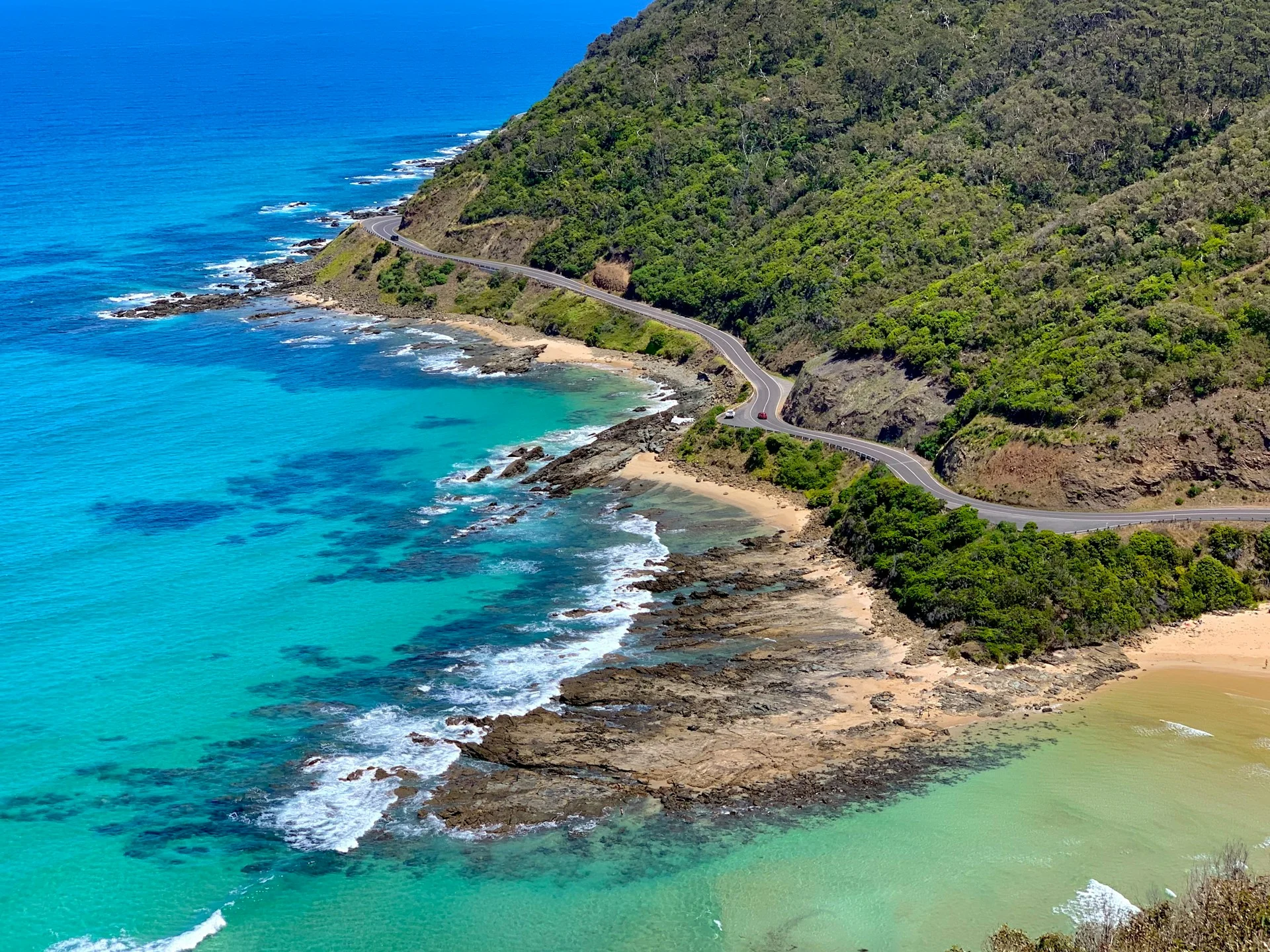
Fringing reef around the coastline. Image credit: Photo by Wee Ping Khoo on Unsplash
Barrier reef
Separated from land by lagoons. Similar to the fringing reef, but further from the shore. Think Great Barrier Reef in Australia.
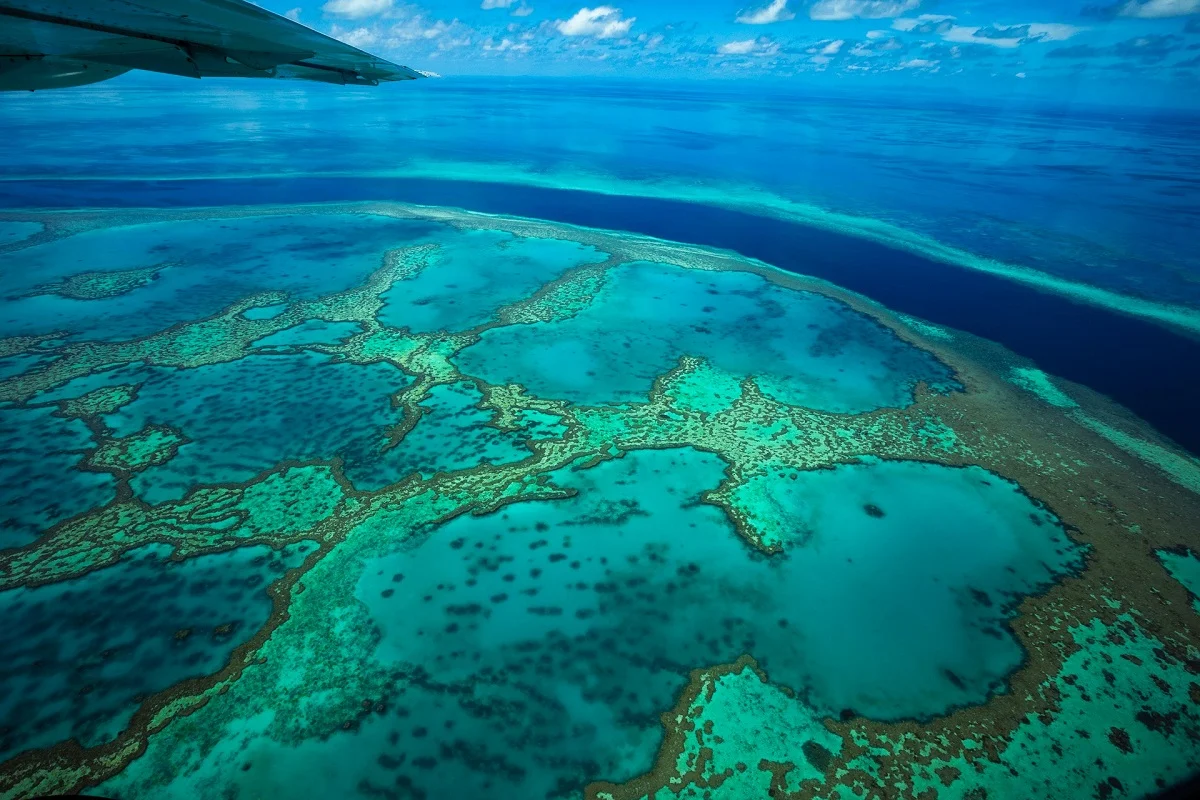
An aerial view of Great Bariier Reef, Austrialia. Image credit: Photo by BehindTheTmuna on Unsplash
Atoll
Usually ring-shaped reefs or series of islets surrounding a body of water – lagoon, sometimes with a central island or submerged volacano. Channels between islets connect the lagoon with the ocean. Think of Maldives, Polynesia, and Micronesia.
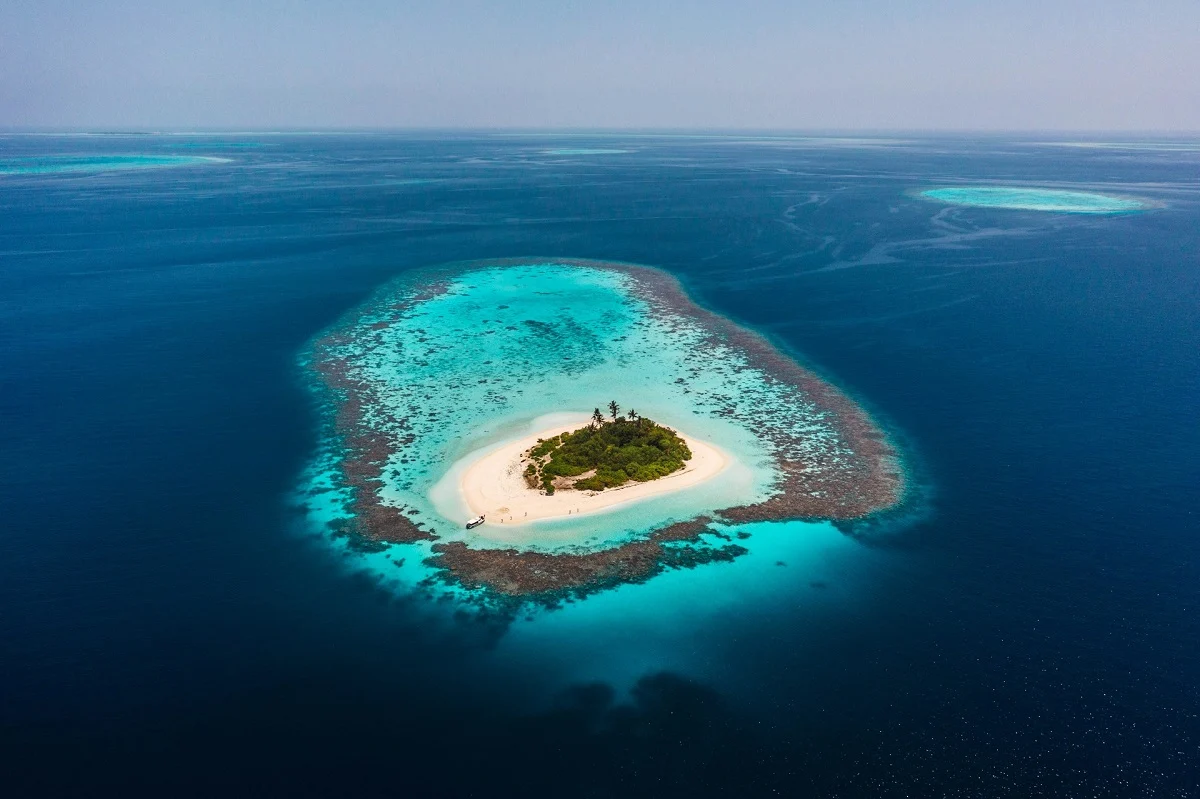
Cluster of small atolls in the Pacific Ocean. Image credit: Photo by Roberto Nickson on Unsplash
Did you know?
Some reef slopes drop thousands of meters into deep ocean waters just beyond recreational dive limits.
Coral Reproduction and Reef Growth
Corals use a dual strategy of sexual and asexual reproduction, allowing them to maintain genetic diversity while also expanding existing colonies.
Sexual Reproduction
Sexual reproduction involves the release of eggs and sperm into the water column, where fertilization occurs externally. This method enables genetic exchange between different coral colonies, promoting diversity and resilience within coral populations.
Some coral species reproduce through internal fertilization, where eggs are fertilized inside the polyp’s body before developing into larvae that are later released into the water.
One of the most remarkable natural events in coral ecosystems is coral spawning. During this event, many coral colonies release eggs and sperm into the water simultaneously. This synchronization is often triggered by environmental cues such as lunar cycles, water temperature, and seasonal changes. Mass spawning typically occurs once a year and greatly increases the chances of successful fertilization, helping maintain healthy and genetically diverse coral populations.
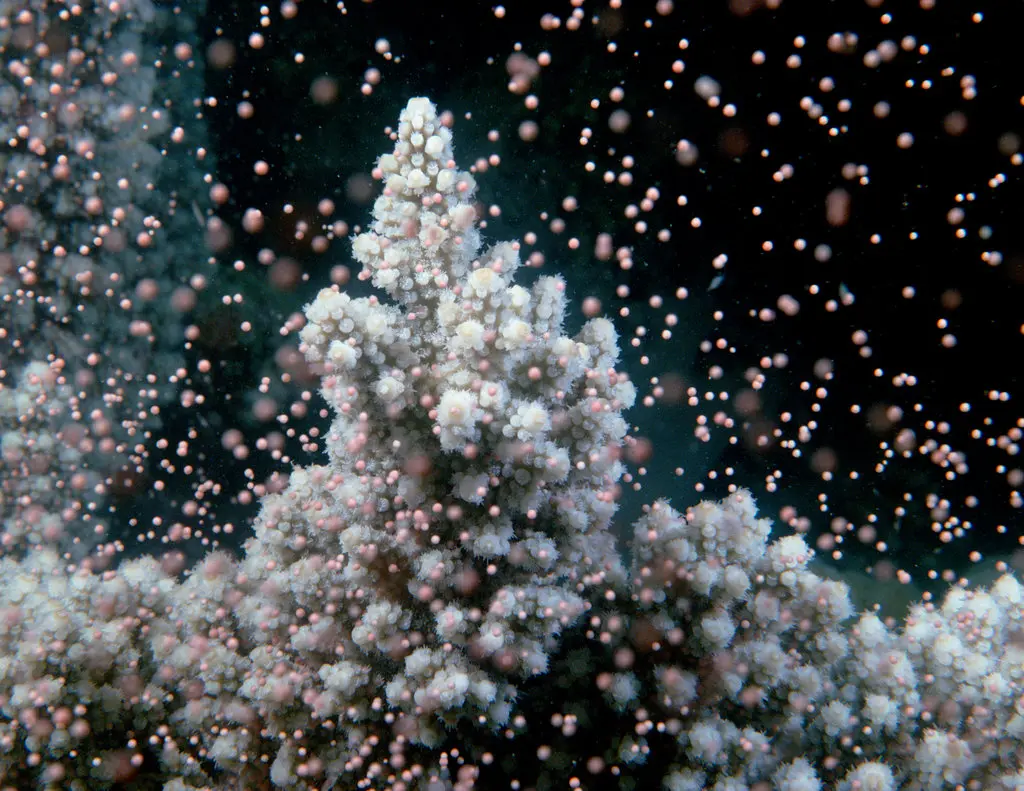
Spawning coral. Image credit: Fred Bavendam/Minden Pictures
Asexual Reproduction
Corals can also reproduce asexually, allowing colonies to grow and expand locally.
One common method is fragmentation, where a piece of coral breaks off—often due to waves or storms—and settles on the reef, where it can grow into a new colony.
Another method is budding, in which new polyps grow directly from the parent coral. Over time, these polyps develop into a larger colony, similar to how new shoots grow from a houseplant.
Where Are Coral Reefs Found?
Corals are found in a variety of marine environments around the world, but they typically thrive in warm, tropical waters within specific latitudinal bands. The greatest diversity of coral reefs is found in tropical regions near the equator, roughly between 30 degrees north and 30 degrees south latitude. However, some corals can also be found in subtropical and temperate regions, particularly along coastlines with warm currents, extending as far as 40 degrees north and south latitude. Each region offers unique coral reef ecosystems and diving conditions.
Major reef regions include:
- The Caribbean Sea
- The Red Sea
- The Great Barrier Reef
- The Coral Triangle
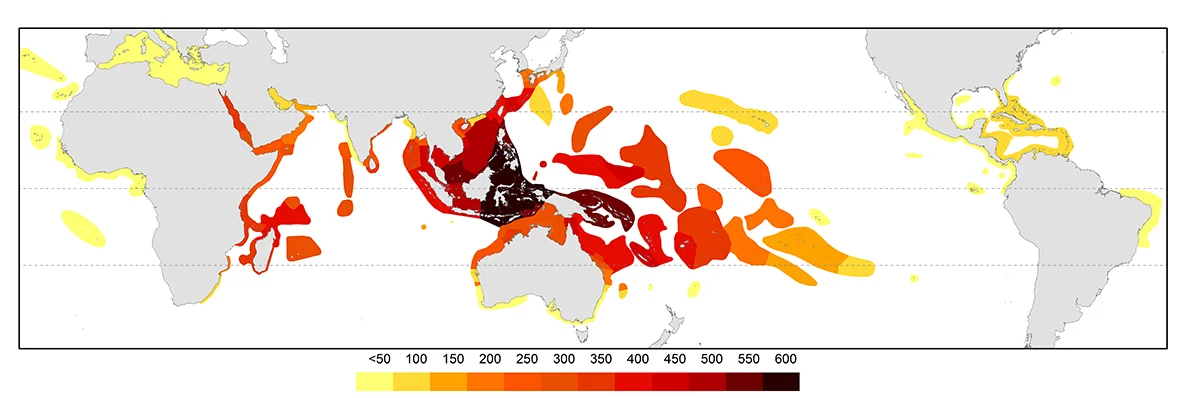
Number of coral spieces. Image credit: Corals of the World, Veron J.E.N., Stafford-Smith M.G., Turak E. and DeVantier L.M. (2016)
Responsible Coral Reef Diving & Conservation
Coral reef diving offers extraordinary beauty — but it also comes with responsibility. Even minor contact can damage coral colonies. Just one accidental fin kick can destroy decades of coral growth. that took decades to grow.
What to do
- Maintain excellent buoyancy control
- Keep fins away from the reef
- Secure gauges and equipment
- Use reef-safe sunscreen
- Follow local dive regulations
- Support marine protected areas
What not to do
- Do not touch or stand on coral
- Do not chase marine life
- Do not collect shells or coral fragments
- Do not anchor boats on reef structure
Do not use sunscreen containing substances that can damage corals. These substances include:
- Oxybenzone (Benzophenone-3)
- Octinoxate (Ethylhexyl Methoxycinnamate)
- Octocrylene
- 4-Methylbenzylidene Camphor (4-MBC)
- Butylparaben
- Octocrylene
Responsible diving is one of the most direct forms of coral reef conservation. Poor buoyancy is one of the leading causes of diver-related reef damage.
Coral Bleaching: The Biggest Threat to Coral Reefs
Coral bleaching occurs when corals become stressed — most commonly due to rising sea temperatures, but also because of pollution, sedimentation, or sudden environmental changes.
Corals live in a delicate partnership with microscopic algae called zooxanthellae. These algae provide up to 90% of the coral’s energy through photosynthesis and are responsible for the reef’s vibrant colors.
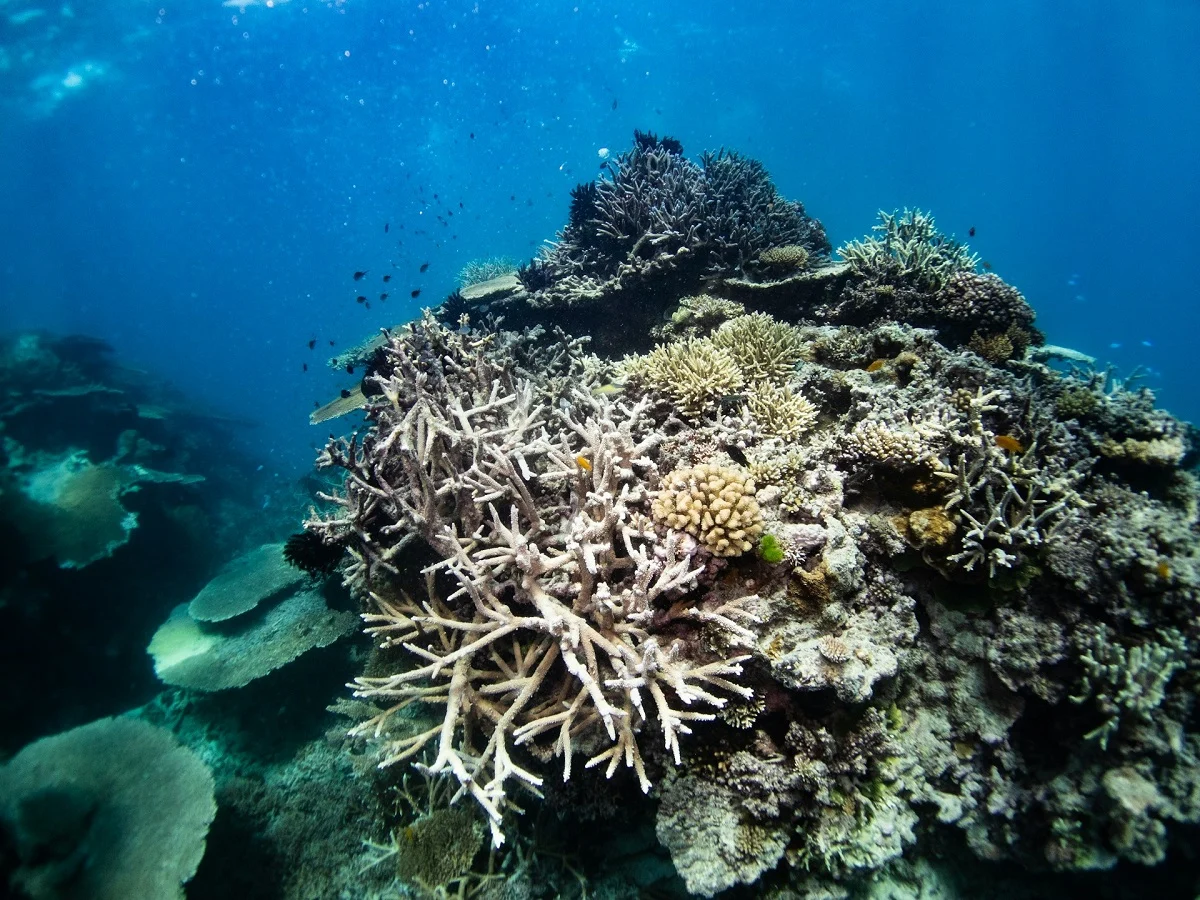
When water temperatures rise even 1–2°C above normal seasonal averages, corals become stressed and expel these algae. Without zooxanthellae:
- Corals lose their color (turning white or “bleached”)
- They lose their primary food source
- Their immune systems weaken
- Growth slows dramatically
What is coral bleaching? Video credit: Great Barrier Reef Foundation
Did you know?
Bleached corals are not immediately dead — but they are in survival mode. If stressful conditions continue for weeks or months, mortality rates increase dramatically.
Why Coral Bleaching Matters for Divers
For divers, bleaching transforms vibrant reef systems into ghostly white landscapes. Fish populations decline, biodiversity decreases, and reef structure weakens. Mass bleaching events linked to climate change have already affected places like Great Barrier Reef, Maldives. Red Sea. Some reefs show resilience and recovery. Others may take decades to return — if at all.
Other Threats to Coral Reef Ecosystems
Coral reefs also face:
- Ocean acidification
- Overfishing
- Destructive fishing methods
- Plastic pollution
- Coastal development
Coral Reef Restoration Projects
Around the world, restoration initiatives are working to rebuild degraded reefs using coral nurseries, artificial structures, and assisted propagation techniques.



Frequently Asked Questions About Coral Reefs
What are coral reefs made of?
Coral reefs are built from calcium carbonate skeletons produced by tiny marine animals called coral polyps. Over thousands of years, these skeletons accumulate and form massive reef structures.
Why are coral reefs important?
Coral reefs support over 25% of marine species, protect coastlines from storms, sustain fisheries, and generate billions in tourism revenue worldwide.
What causes coral bleaching?
Coral bleaching is primarily caused by rising sea temperatures. When stressed by heat, corals expel their symbiotic algae (zooxanthellae), losing both color and vital nutrients.
Can coral reefs recover after bleaching?
Yes — if water temperatures return to normal quickly, corals can regain their algae and recover. However, repeated or prolonged bleaching can lead to reef mortality.
How can divers help protect coral reefs?
Divers can protect reefs by maintaining good buoyancy control, avoiding contact with coral, using reef-safe sunscreen, supporting marine protected areas, and choosing ethical dive operators.